
What happens in an HSE inspection of a small business?
15 minutes read | Published on June 5, 2026
Updated on July 22, 2026
Written by  Lee Mills.
If the Health and Safety Executive (HSE) decides to inspect your business, an inspector will arrive (announced or unannounced) and assess whether your workplace complies with UK health and safety law. If the inspector doesn’t find any problems, you won’t pay anything and the inspector will confirm that verbally at the closing meeting. If they do identify a material breach, the consequences can be serious, including prosecution and financial penalties.
The HSE carried out over 13,200 workplace inspections in 2024/25, according to the HSE’s Annual Report. Any business can receive an HSE inspection, regardless of size.
Knowing what to expect before an inspector arrives is the single most effective way to reduce the risk of enforcement action.
Key takeaways
| Question | Answer |
|---|---|
| Who carries out health and safety inspections? |
|
| Will the HSE tell me they’re coming? | HSE inspectors can and do arrive unannounced |
| What triggers an HSE inspection? |
|
| What can an inspector do? |
|
| What does an inspection cost if I’m compliant? | There is no charge if no material breach is found |
| What does it cost if I’m in breach? | A Fee For Intervention (FFI) is charged at £188 per hour from 1 April 2026; the average FFI invoice is around £1,160 |
| What are the most serious outcomes? | An Improvement Notice, a Prohibition Notice, or prosecution — which can result in an unlimited fine and up to two years in prison for individuals |
What is an HSE inspection?
An HSE inspection is an official visit by a health and safety inspector to check that your workplace complies with UK health and safety law (primarily the Health and Safety at Work etc. Act 1974).
The Health and Safety Executive (HSE) is the national regulator for workplace health and safety in Great Britain. Under section 20 of the Health and Safety at Work etc. Act 1974, HSE inspectors have wide statutory powers to enter, examine, and investigate any workplace. Inspections can range from a short visit to check one specific concern, to a full-day examination of a business’ premises, documentation, and systems.
Who carries out health and safety inspections in the UK?
Not all UK workplaces fall under HSE jurisdiction. The Health and Safety (Enforcing Authority) Regulations 1998 split enforcement responsibility between the HSE and Local Authorities.
| Regulator | Sectors covered |
|---|---|
| Health and Safety Executive (HSE) | Manufacturing, construction, agriculture, quarrying, chemical and nuclear sites, hospitals, schools |
| Local Authority Environmental Health Officer (EHO) | Offices, retail, restaurants, hotels, leisure facilities, warehouses used for retail distribution |
| Fire and Rescue Service | Fire safety enforcement across most non-domestic premises, including workplaces, under the Regulatory Reform (Fire Safety) Order 2005 |
HSE covers higher-risk industries, whereas Local Authority Environmental Health Officers (EHOs) cover lower-risk settings. For example, if you run an office or a café, your first inspector is likely to be a Local Authority EHO rather than an HSE inspector. Both regulators carry the same legal powers for conducting inspections, and the inspection process is the same regardless of who turns up.
Why would HSE inspect my small business?
There is no single trigger. The HSE selects businesses for inspection based on:
- Any incident you’re legally required to report under the Reporting of Injuries, Diseases and Dangerous Occurrences Regulations 2013 (RIDDOR) is likely to prompt a follow-up inspection
- A complaint from an employee, contractor, member of the public, or trade union representative can trigger an HSE inspection
- Targeted inspection campaigns (the HSE runs sector-specific programmes each year; recent examples include over 3,100 construction inspections and more than 600 asbestos management inspections in a single year)
- A follow-up to a previous Improvement Notice, Prohibition Notice, or Notification of Contravention
- Intelligence from other regulators or a related incident at a similar site
Small businesses are not exempt from any of these triggers. A single reportable accident or a single complaint is enough to bring an inspector to your door.
Will the HSE tell me they are coming?
Not always. HSE inspectors can arrive unannounced, and proactive and unannounced visits have been increasing. The HSE’s own guidance (What to expect when a health and safety inspector calls, HSC14) confirms that inspectors may visit without warning if they think announcing the visit would undermine the purpose of the inspection (for example, where an inspector suspects hazards might be hidden or corrected before they arrive).
Some inspections do come with notice, like those arising from a planned sector campaign or a follow-up where the inspector has agreed on a timescale with the business. But you should not assume you will always receive advance warning.
What powers does an HSE inspector have?
In practice, an HSE inspector can do most things they need to without asking your permission first:
- Walk into your workplace at any reasonable time (or immediately if they think there’s a dangerous situation)
- Bring police with them if they think there might be trouble
- Look at any part of your premises, including machinery, equipment, and substances
- Take measurements, photos, samples, and recordings
- Go through any of your documents or records (both physical and digital records)
- Talk to your staff and contractors, separately from you if they want to
- Ask you to give them reasonable access and assistance
- Take equipment away for testing if they need to
- Issue a formal notice on the spot if they find a breach or an imminent risk
An inspector does not need a warrant to enter a workplace. Obstructing or failing to cooperate with an inspector is a criminal offence under section 33 of the Health and Safety at Work etc. Act 1974.
What happens during an HSE inspection step by step?
Most HSE inspections follow the same sequence:
- Opening meeting: The inspector will introduce themselves, explain why they’re there, and ask someone to accompany them for the visit. That’s usually you (the business owner), your site manager, or whoever looks after health and safety day-to-day.
- Site walk-round: They’ll walk around the premises with you, and look at how you’re actually getting work done. At this point, they’re checking whether you’re controlling hazards effectively, whether equipment is safe, and whether what’s happening on the ground matches what your policies say should happen.
- Document and records review: The inspector will ask to see your health and safety records. (This is where having organised paperwork pays off. An inspector who has to wait while you hunt for a risk assessment is already forming an impression of your business.)
- Staff interviews: The inspector may want to speak to some of your employees separately. This isn’t something to worry about if your team works safely day-to-day; it’s just their way of checking that written procedures reflect reality on the ground.
- Closing meeting: Before they leave, the inspector will talk you through what they’ve found, including any concerns they have. This is also your opportunity to ask questions.
- Written feedback: After the visit, you’ll hear from HSE in writing. You’ll receive confirmation that everything was in order, or if they identified a breach, you’ll receive a formal Notification of Contravention, an Improvement Notice, or a Prohibition Notice (depending on how serious the issue was).
How long an inspection takes depends on what the inspector finds. A routine visit to a small business where the paperwork is in order and there are no obvious concerns will typically wrap up in two to three hours. But if the inspector identifies issues during the walk-round, or if the visit is connected to a serious accident or a fatality, it can take significantly longer. Complex investigations can take up to a full day on site, and in serious cases the inspector may need to return for follow-up visits before they’re satisfied.
The best way to keep the visit short is to make sure you’ve organised your documents and your site is in good order before they arrive.
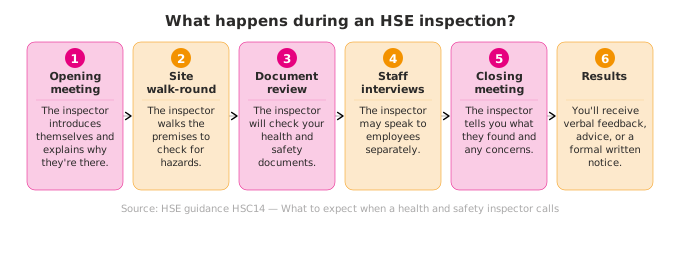
What happens during an HSE inspection, from the opening meeting to the outcome. Source: HSE guidance HSC14, What to expect when a health and safety inspector calls.
What documents will an HSE inspector ask to see?
Have these organised and accessible before an inspector arrives. Inspectors most commonly ask for these documents, but may request more records depending on your industry and the nature of your work.
| Document | What you need |
|---|---|
| Health and safety policy | If you employ five or more people, you’re legally required to have a written health and safety policy under the Health and Safety at Work etc. Act 1974. Make sure it’s signed and dated. |
| Risk assessments | The Management of Health and Safety at Work Regulations 1999 requires you to have written risk assessments if you employ five or more people. They need to cover all significant risks to your employees and anyone else affected by your work. |
| Training records | The inspector will want to see evidence that you’ve properly trained your employees, including their induction, any task-specific training, and refresher training. |
| Accident book and RIDDOR reports | You should have a record of all workplace injuries and near misses, along with confirmation that you reported any RIDDOR-reportable incidents to the HSE when they happened. |
| Maintenance and inspection records | Logbooks for your plant, equipment, machinery, lifting equipment, and pressure systems. You need to be able to show that you’re regularly checking your equipment. |
| Control maintenance records | Records of thorough examinations and tests for engineering controls such as local exhaust ventilation (LEV). LEV systems require thorough examination at least every 14 months under COSHH Regulations 2002. |
| Health surveillance records | If employees are exposed to noise, vibration, or hazardous substances, you may need to carry out health surveillance and keep records of the results. |
| COSHH assessments | If your business uses hazardous substances or materials, you need Control of Substances Hazardous to Health assessments in place. |
| Fire risk assessment | Required under the Regulatory Reform (Fire Safety) Order 2005. If you haven’t reviewed your Fire Risk Assessment recently, do it before an inspector arrives. |
| Consultation records | Evidence that you’re talking to your employees or their representatives about health and safety matters on a regular basis. |
If documents are missing, out of date, or clearly not implemented, the inspector is likely to treat this as a material breach.
What are the possible outcomes of an HSE inspection?
| Outcome | What it means | What it costs you |
|---|---|---|
| No action | The inspector left satisfied. You get written confirmation that everything was in order. | Nothing |
| Verbal advice | The inspector spotted something minor and flagged it verbally. No formal action, but take it seriously and sort it. | No formal charge, but don’t ignore it |
| Notification of Contravention | The inspector found a material breach and put it in writing. This is the point where FFI charges start. | FFI at £188/hr. Typically around £1,160 for a straightforward case |
| Improvement Notice | A formal legal notice telling you to fix a specific problem within a set timeframe. If you receive an improvement notice you have at least 21 days to fix the problem, and work can continue while you sort it. | FFI at £188/hr plus whatever it costs to put things right; worth getting legal advice. |
| Prohibition Notice | The inspector has decided a work activity is putting someone at serious risk of injury. You have to stop that activity immediately — it can’t restart until the inspector is satisfied you’ve fixed the problem. | FFI at £188/hr plus remediation costs; the work stoppage alone can be expensive |
| Prosecution | The HSE has referred your case for criminal prosecution. This happens in the most serious cases, or where an employer has repeatedly ignored enforcement action. | Potentially unlimited fines; individuals can face up to 12 months in prison in the Magistrates’ Court, or up to two years in the Crown Court |
The more serious outcomes don’t end when the inspector walks out the door — some require action from your business:
- Prohibition Notice: Takes effect immediately. You must stop the relevant work activity until the breach is rectified and the inspector is satisfied.
- Improvement Notice: You can appeal to an Employment Tribunal within 21 days and the notice will be automatically suspended while the tribunal hears your appeal.
- Prosecution: The HSE reserves this for the most serious breaches, repeat offending, or cases where a notice alone is not sufficient.
What is Fee for Intervention (FFI) and when does it apply?
Fee for Intervention (FFI) is a cost-recovery scheme the HSE introduced under the Health and Safety (Fees) Regulations 2012. The idea is straightforward: rather than the public footing the bill for enforcement activity, the businesses that break health and safety law pay for it instead.
FFI applies as soon as an inspector identifies a “material breach”. A material breach is any contravention serious enough that they’re required to notify you in writing. From the point the HSE identifies a material breach, it’ll charge you for all the time it spends on your case: time on site, preparing documentation, issuing notices, getting specialist input, and any follow-up visits.
From 1 April 2026, the HSE charges FFI at £188 per hour, following an annual review approved by minister Sir Stephen Timms MP. If the inspector doesn’t find a material breach, you won’t have to pay anything.
FFI costs vary depending on the number and severity of breaches, whether specialist input is needed, and how many interactions it takes to get compliance signed off. The more straightforward the case and the quicker you resolve it, the lower the bill. According to HSE’s own data, the average invoice was around £1,160 across all FFI cases in 2024/25.
What penalties can a business face after an HSE inspection?
Penalties depend on how serious the offence is and which court hears the case. The Sentencing Council’s Health and Safety Offences, Corporate Manslaughter, and Food Safety and Hygiene Offences definitive guideline (in force from 1 February 2016) lists the penalties as:
- Organisations convicted of breaching sections 2 to 6 of the Health and Safety at Work etc. Act 1974 face unlimited fines at both the Magistrates’ Court and Crown Court
- Individuals convicted on indictment face an unlimited fine and up to two years in prison
- The Magistrates’ Court can impose up to 12 months’ imprisonment for individuals
Courts work out fines against a company’s turnover, not profit. For example, a small business with a £1m turnover can still face a six-figure fine for a serious breach.
Beyond fines and FFI, a conviction is public. The HSE publishes prosecution outcomes on its website and issues press releases, which can damage your reputation with clients and subcontractors. But you don’t need to be prosecuted for your business to appear on the public record. The HSE publishes Improvement Notices and Prohibition Notices on its public register of enforcement notices five weeks after they’re served, where they remain searchable for five years.
HSE inspection example: Manufacturing business
A small fabrication business with 12 employees gets an unannounced visit from an HSE inspector, following an anonymous complaint about machinery guarding.
During the site walk-round, the inspector finds two problems: a machine with inadequate guarding around a rotating part, and no risk assessment for that specific operation.
She judges both to be material breaches. That afternoon, she issues a Notification of Contravention and an Improvement Notice requiring the business to fit proper guarding and complete the risk assessment within 28 days. The FFI starts from the point of the Notification of Contravention.
| Item | Cost |
|---|---|
| HSE inspector time on site (3 hours × £188) | £564 |
| Office time preparing the Notification of Contravention and Improvement Notice (approx. 2–3 hours) | £376–£564 |
| Total FFI invoice | approximately £940–£1,128 |
| Replacement guarding and installation | £800 |
| Total direct cost to the business | approximately £1,740–£1,928 |
Had the business completed the risk assessment and checked the guarding during a routine internal inspection, the visit would have cost the business nothing.
How should my business prepare for an HSE inspection?
You can’t guarantee you’ll never get an inspection, but you can make sure that when one happens, the inspector finds nothing to act on:
- Walk your premises as an outsider: Look at your site the way an inspector would. Are guards in place? Is housekeeping up to scratch? Fix anything you wouldn’t want someone with a clipboard to see.
- Review your risk assessments: Check that they cover your current activities, that they’re signed and dated, and that someone reviews them whenever your work activities change.
- Check your training records: Confirm that every employee has completed the training your risk assessments have specified they need to take.
- Update your accident book: Make sure you’ve recorded all incidents and near misses, and that you reported any RIDDOR-reportable events to the HSE within the required timescales.
- Organise your documents: Keep your health and safety policy, risk assessments, training records, maintenance logs, and COSHH assessments somewhere you can put your hands on them quickly.
- Brief your managers: Make sure anyone who might receive an inspector knows to cooperate calmly, answer questions honestly, and call your health and safety advisor as soon as possible.
- Act on any previous advice: If the HSE or an EHO has already given you written advice, make sure you’ve implemented their advice before an inspector comes back.
- How long does an HSE inspection take?
-
How long an HSE inspection takes depends on what the inspector finds. A routine visit to a small business will typically take two to three hours. If the inspector is investigating a serious accident or fatality, they may need to come back for multiple visits over several days. The best way to keep it short is to have your paperwork organised and your site in good shape before they arrive.
- Can the HSE turn up unannounced?
-
HSE inspectors can and do turn up unannounced, and it happens more often than people expect. Inspectors are more likely to arrive without warning if the HSE has received a complaint about your business, is running a targeted sector campaign, or thinks advance notice might change what they find. It's worth running your site as if an inspector could walk in at any time.
- Do I have to let an HSE inspector in?
-
You do have to let an HSE inspector in when they show up to conduct an inspection. Section 20 of the Health and Safety at Work etc. Act 1974 gives inspectors the right to enter your workplace at any reasonable time without a warrant. Refusing entry or obstructing an inspector is a criminal offence under section 33 of the same Act.
- What is a Material Breach?
-
A Material Breach is a contravention of health and safety law serious enough that the inspector must notify you in writing. It’s also the point where the inspection stops being a routine check and starts costing you money. From the moment the inspector issues that written notification, FFI charges start.
- What is the difference between an Improvement Notice and a Prohibition Notice?
-
An Improvement Notice and a Prohibition Notice are both formal legal notices, but they work differently. An Improvement Notice gives you at least 21 days to fix a specific problem, and you can keep working while you sort it out. A Prohibition Notice is more serious; the inspector is telling you to stop a specific work activity immediately because they believe it puts someone at risk of serious injury. You can't restart until you've fixed the problem and the inspector is satisfied you've done it properly.
- How much does Fee for Intervention cost per hour?
-
From 1 April 2026, the HSE charges Fee for Intervention (FFI) at £188 per hour. That rate has gone up every year since the scheme launched in 2012 at £124 per hour, and it will keep rising. The total invoice covers everything the HSE spends time on from the point they identify a Material Breach: the site visit, office work, preparing notices, and any follow-up visits.
- Can I appeal an HSE Improvement Notice or Prohibition Notice?
-
You can appeal both an Improvement Notice and a Prohibition Notice to an Employment Tribunal. For an Improvement Notice, you have 21 days from receiving it to appeal, and the tribunal automatically suspends the notice while your appeal is heard. For a Prohibition Notice, the tribunal won't automatically suspend it; you need to apply for that separately. Either way, you should get independent legal advice before you appeal.
- Will the HSE name and shame my business after an inspection?
-
Whether the HSE publishes information about your inspection depends on the outcome. If the inspector issues no formal notice, nothing appears on the public record. If the HSE issues an Improvement Notice or Prohibition Notice, it will appear on the HSE's public register of enforcement notices five weeks after it's served, where it remains searchable for five years. If the HSE prosecutes you and secures a conviction, they publish the details (including your business name, the offence, and the penalty) on the HSE's public register of convictions.
Get support before and after an HSE inspection
Citation clients are 47 times less likely to face an HSE enforcement notice. Our advisors work with you to review your documentation, support you during inspections, and defend any prosecution under our health and safety advice guarantee.
Talk to a health and safety advisor today.