
How the new 6-month unfair dismissal rights affect probation periods: a 2026 guide for UK employers
7 minutes read | Published on June 30, 2026
Updated on September 16, 2026
Written by  Gillian McAteer.
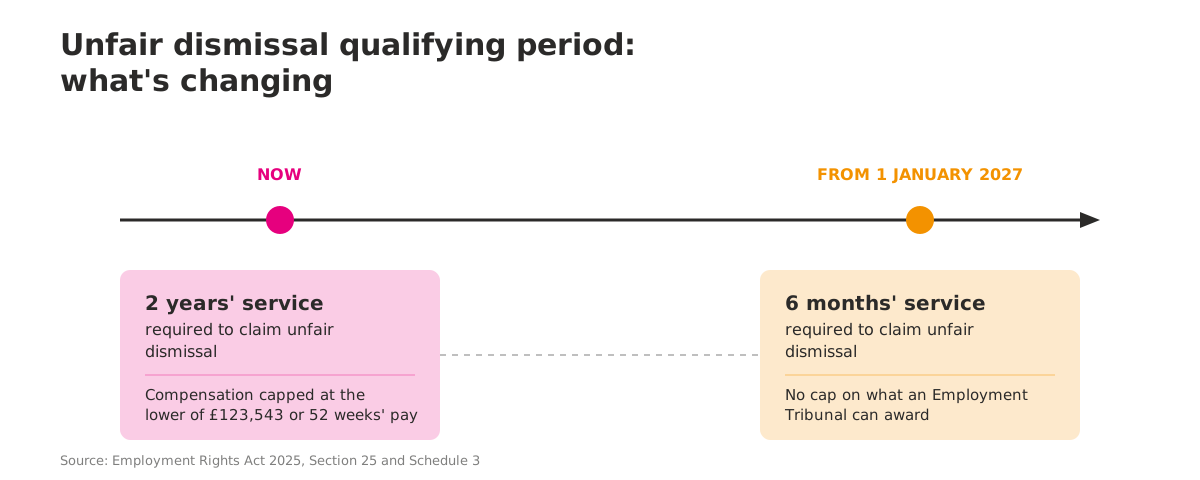
From 1 January 2027, employees will gain the right to claim unfair dismissal after just six months in a job. The Employment Rights Act 2025 cuts the current two-year qualifying period to six months and removes the cap on what an Employment Tribunal can award if a dismissal is found to be unfair.
For most UK businesses, that means probation periods are about to get a lot riskier. Right now, a standard six-month probation period sits comfortably inside the two-year qualifying period, giving you room to assess and exit new starters without the risk of unfair dismissal claims. From January 2027, it won’t. Any dismissal at or after that six-month point will need a fair reason, a documented process, and the evidence to back it up.
Key takeaways
| Question | Answer |
|---|---|
| What is the current qualifying period for unfair dismissal protection? | Two years’ continuous employment |
| What will the new qualifying period for unfair dismissal protection be from 1 January 2027? | Six months’ continuous employment |
| When will the new qualifying period for unfair dismissal come into force? | 1 January 2027, as confirmed by the government |
| Will the compensation cap for unfair dismissal still apply after 1 January 2027? | No. After 1 January 2027, the compensation cap for unfair dismissal will be removed entirely |
| Will day-one protections against automatically unfair dismissal change under the Employment Rights Act 2025? | No. Automatic protections, including those covering pregnancy, whistleblowing and trade union activity, will continue to apply from day one of employment |
| How many workers will gain new unfair dismissal rights on 1 January 2027? | Around 6.3 million employees currently have between six months’ and two years’ service and will gain protection on that date |
| What must employers do differently when dismissing an employee with six or more months’ service? | Follow a fair process with a fair reason, and document the decision throughout |
What does the Employment Rights Act 2025 change about unfair dismissal?
Section 25 of the Employment Rights Act 2025 reduces the qualifying period for protection against ordinary unfair dismissal from two years to six months. The Act also permanently removes the government’s power to change the qualifying period through secondary legislation, meaning any future government wanting to reverse this change would need primary legislation to do it.
At the same time, the Act removes the existing cap on compensatory awards. As of 6 April 2026, that cap sits at the lower of £123,543 or 52 weeks’ gross pay. From 1 January 2027, that ceiling will disappear entirely. Gill McAteer, Director of Employment Law at Citation, puts the practical implication clearly: “You can’t say ‘well, the most I’m going to have to pay out is a year’s salary for this employee’ — that kind of risk management will effectively be removed.”
The government’s unfair dismissal factsheet, published by GOV.UK, also confirms that Schedule 3 to the Act reduces the qualifying period for an employee’s right to request written reasons for dismissal from two years to six months. After 1 January 2027, any employee with six months’ service will be able to formally request written reasons if you dismiss them.
How does this affect probation periods specifically?
The impact on probation periods is where the new change hits hardest.
According to ONS Business Insights data, around 40% of businesses operate discretionary probationary periods, and the vast majority are six months or less. It’s likely this number is even higher than reported, however; at Citation, virtually every one of our HR & Employment Law clients has a probationary period, and six months is seen as the default. The government’s stated rationale is that a six-month qualifying period “ensures employers retain the ability to properly assess whether new recruits are a good fit during their first months of employment.”
The challenge for businesses who currently rely on a six-month probationary period is that from 1 January 2027, the end of the six-month probation window aligns almost exactly with the point at which the employee gains unfair dismissal rights. You’ll need to handle any dismissal at the end of a standard six-month probation period with the same care as any other dismissal: fair reason, fair process, documented throughout.
As Gill McAteer explains: “For years, if someone came to me and wanted to cut some legal corners on a dismissal, the first thing they’d say was ‘don’t worry, they’re short service.’ But from January, this window of ‘short service’ will be much narrower.”
What process must you follow to dismiss someone after 6 months’ service?
From 1 January 2027, dismissing an employee with six or more months’ service requires a fair reason and a fair procedure. Acas guidance confirms that a fair dismissal procedure should follow the Acas Code of Practice on disciplinary and grievance procedures.

In practice, for a probationary dismissal, you should:
- Hold a formal meeting. Give the employee advance notice of the meeting and the issues you are raising.
- Set out the reasons in writing. Explain clearly why the employee’s performance or conduct hasn’t reached the required standard.
- Allow the right to be accompanied. The employee has the right to bring a trade union representative or a workplace colleague.
- Give the right of appeal. Tell the employee how to appeal and give them a reasonable opportunity to do so.
Not following this process doesn’t automatically make a dismissal unfair, but if the employee brings a claim, an Employment Tribunal can apply an uplift of up to 25% on any award where the Acas Code hasn’t been followed.
If you’re unsure whether your current probation process covers all of this, Citation’s employment law advisers can review it with you and flag anything that needs updating before January 2027.
What are the risks of dismissing an employee after 6 months without following the right process?
From 1 January 2027, getting a dismissal wrong could cost you more.
There’s no longer a cap on what a tribunal can award. Right now, even if a tribunal finds against you, the compensatory award is capped at £123,543 or 52 weeks’ gross pay, whichever is lower. From January 2027, that ceiling won’t exist.
What you could owe depends on the employee’s salary, their career prospects, and how long it takes them to find another job — and there’s no upper limit. Gill McAteer also points out that removing the cap will change what employees expect their claim to be worth, which makes reaching an early settlement a lot harder.
Do existing probation clauses in employment contracts still work?
Many employment contracts include a clause allowing a simplified disciplinary process for employees with short service. Until now, “short service” has effectively meant “under two years.” From 1 January 2027, that clause will only cover the first six months of employment.
Before the commencement date, you should review your contracts, policies and manager guidance. In particular, you should:
- Review the length of your probationary periods
- Revise your probationary review processes to ensure they include formal check-ins, documented performance feedback, and a clear outcome meeting
- Give training to line managers to ensure they understand new processes and the importance of consistently applying them
Worked example: retail employer and extended probation
A retail business takes on a new team leader on 7 July 2026 with a three-month probationary period. She struggles with the role from the start — her manager has a couple of informal chats but doesn’t write anything down. At three months, rather than making a decision, the manager extends her probation by a further three months to give her more time to improve, but still doesn’t document why or what “improvement” actually looks like.
At six months, not much has changed. The manager holds a probationary review meeting on 5 January 2027 and decides to let her go, paying her in lieu of notice. The manager assumes that because she’s still within her probation period, the risk is low.
However, her dismissal falls after the new rules have come into effect. As she didn’t work her notice, her length of service for unfair dismissal purposes is calculated by adding on her one-week statutory notice to her termination date, taking her beyond 6 months’ service.
The problem
There’s no written record of the performance concerns, no documented targets from the probation extension, and nothing to show what support she was offered. The dismissed employee can bring an unfair dismissal claim — and with the compensation cap removed, there’s no ceiling on what a tribunal could award.
The risk
If the worker was earning £35,000 a year, and it took her nine months to find a comparable job, her loss of earnings alone comes to over £26,000. With the loss of pension, and a potential uplift on the award for failing to follow the Acas Code, the total exposure could exceed £30,000. And this is for a dismissal that would have been considered “low risk” before January 2027.
What should you do before 1 January 2027?
The time to act is now, not in December. Any employee who starts work from July 2026 onwards can reach the six-month mark after the commencement date.
Your action checklist:
- Review probation periods. Is 6 months too long given the new risks it will bring?
- Update your disciplinary policy so the short-service provision is correctly aligned with the new rules
- Introduce structured probation reviews. At minimum, build in a formal check-in at two or three months and a documented outcome meeting before the probation period ends
- Document as you go. Written records of concerns, feedback conversations, and performance issues are significantly more persuasive at tribunal than recalled verbal accounts
- Train your line managers. They need to understand that from January 2027, a dismissal after the six-month mark needs the same procedural care as any other dismissal
As Gill McAteer puts it: “If you have the right processes in place, if you’re confident that you are documenting things consistently — okay, you might face an unfair dismissal claim. But you are going to be in a great position to successfully defend it because you will have all that evidence.”
Quick answers
- When does the 6-month unfair dismissal qualifying period come into force under the Employment Rights Act 2025?
-
The government has confirmed 1 January 2027 as the commencement date for the unfair dismissal qualifying period change under the Employment Rights Act 2025.
- Does the Employment Rights Act 2025 give employees unfair dismissal rights from day one of employment?
-
No. The Employment Rights Act 2025 reduces the qualifying period for ordinary unfair dismissal to six months, not zero. Day-one unfair dismissal rights were proposed but were dropped from the Bill after stiff opposition from the House of Lords. Automatically unfair grounds, including pregnancy, whistleblowing and trade union activity, continue to apply from the first day of employment regardless of service length.
- Can employers still set a 3-month or 6-month probation period in employment contracts?
-
Yes. The Employment Rights Act 2025 doesn't prohibit contractual probation periods. The change is to the statutory qualifying period for unfair dismissal rights. If your contractual probation period is six months, it now aligns with the point at which employees gain full unfair dismissal protection, rather than sitting comfortably inside it.
- What counts as a fair reason for dismissal once an employee has six months' service?
-
After 1 January 2027, you can only fairly dismiss an employee with six months' service for one of five statutory fair reasons: capability, conduct, redundancy, statutory illegality, or some other substantial reason. Employees dismissed during the first six months can still challenge the decision on automatically unfair grounds or on grounds of discrimination from day one.
- Will the new unfair dismissal rules apply to part-time and zero-hours workers?
-
The Employment Rights Act 2025 applies to employees. That includes part-time employees, and zero-hours workers who are classified as employees rather than workers. Zero-hours workers who don't hold employee status aren't covered — however on questions of employment status, the tribunal will look at the true nature of the relationship rather than the label attached to it when deciding whether someone is an employee or a worker. That means there is always a chance that workers who you don't believe hold employee status could be found to meet the criteria for an employee at tribunal.
- Does the 1 January 2027 change affect employees who started work before that date?
-
Employees who already have six months' service on 1 January 2027 will gain protection immediately on that date.
- Will the qualifying period for constructive dismissal also reduce to six months?
-
Constructive dismissal is a form of unfair dismissal under the Employment Rights Act 1996, so the qualifying period reduction will also apply to these claims.
Need support with your probation process?
The Employment Rights Act 2025 changes the risk profile of every new hire from January 2027. Citation’s HR and employment law advisers can help you review your contracts, update your probation processes, and get your line managers ready before the changes come in. And if a dismissal does go to tribunal, our Advice Guarantee means we’ll defend the claim and pay any award up to £150,000, provided you’ve followed our advice.